Tuesday, 1 February 2011

Some British

Two posts? In one day? I might need a lie down! To go with the French, some British.

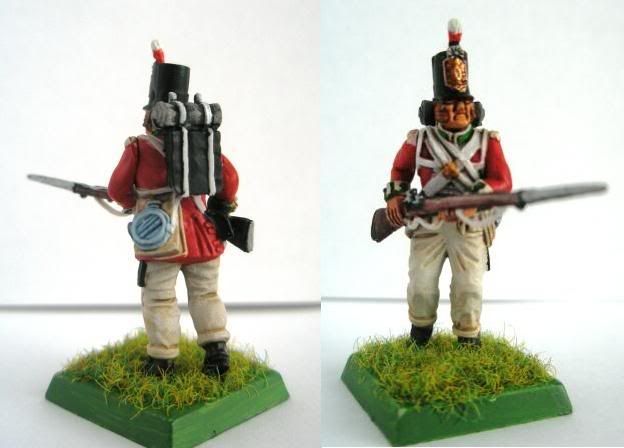
Firstly, an unarmed infantryman in forage cap. In my games I think he's going to be a batman or messenger. I'd have liked to have him without the backpack, but the conversion work in doing that I'll leave for another day. The head is from the French sprue, so I'm not sure if the cap is quite right, and I've guessed colours based on a figure in Uniforms of the Peninsular Wars, substituting facing colours.


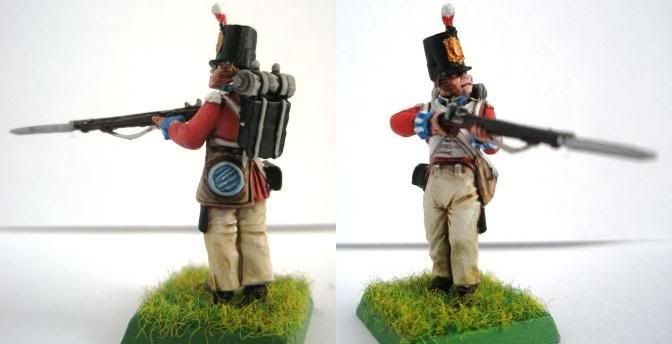
The next is a drummer, in the reversed-facings coat. It's been a bit different painting some green.


The drum on the Victrix models is a bit fiddly to assemble, and casting-wise not the highlight of the set, but painted and on the table it looks fine.

Lastly, someone else not in red- an RFA officer, in the traditional blue coat. The pose is a conversion, with an outstretched hand as if ordering his men.


I'm particularly proud of the face on this model; it's probably the best I've done on my Napoleonics. I tried to photograph it closer, but I didn't get the resolution or focus quite right.


The head, I should mention, comes from the British foot sprue, and not the RFA sprue. One of the great joys of plastics is the almost endless variety in mixing and matching parts.

Some French

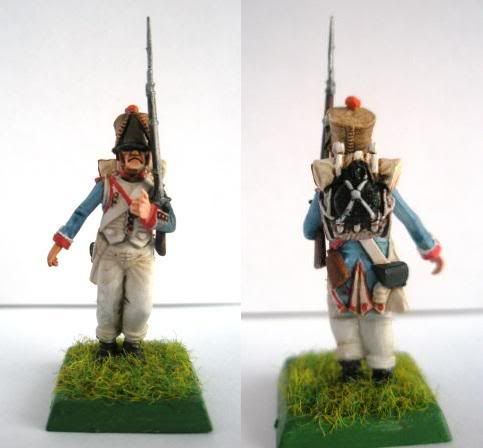
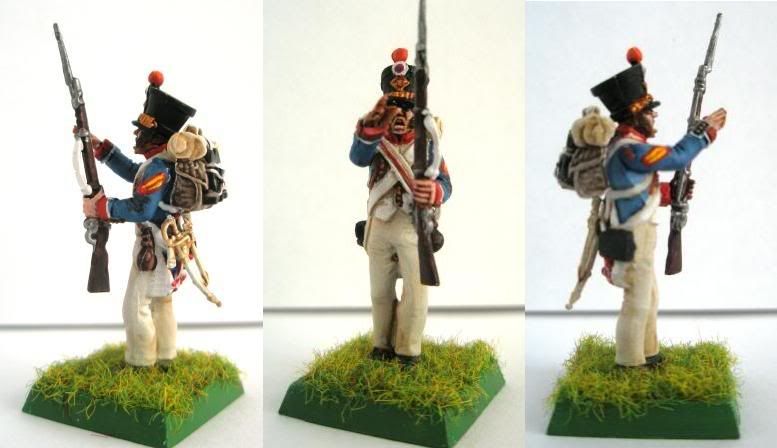
Right, my first proper post in aaages! Here are some pictures of the French I've been working on: a grenadier, left, and a voltigeur, right.


Largely these have been painted as the others on my blog, although the blue of their uniforms is GW's Enchanted Blue with an Asurmen blue wash. It's a much bolder effect, similar to the red+wash I've done on my British. They're both lacking packs and swords, both of which I paint separately.


My first Eagle-bearer, sadly lacking the colours at the moment until I decide whether to do the flag myself, or use a paper one.

Sunday, 9 January 2011

A Change of Name

You may have noticed, my blog has had a change of name. "En Avant!" was okay, but it's a fairly cliché term in Napoleonic gaming and fandom. Instead, I've named my blog after one of the most interesting Napoleonic articles on Wikipedia.

Lord Uxbridge's Leg


Uxbridge lost his leg at Waterloo, which was only the beginning for that poor appendage. Apparently, the original leg led quite a life as a tourist attraction after it's amputation. Uxbridge (as Marquess of Anglesey) also lent his name to the artificial leg designed for him, which featured moving toes.

So then, a worthy (and apt) new name for my blog!

Happy New Year!

Well, this is my first post of 2011, and a chance to reflect on how I want things to go this year.

Paint More

In many ways, painting is the real hobby here. Most gamers probably spend many times more time painting and collecting than actually playing, but it's something of late I've done increasingly less of. Part of it is down to the long winter nights and my lack of good artificial light to paint by, but more of it is down to inertia. For a relaxing activity, painting is surprisingly draining, and it's easier to switch on the Idiot Box than get out the brushes.

So this year I'm setting myself targets. Of course, the danger with targets is that standards will drop, and I like painting to my best. Hopefully, I'll get the best result which will be more miniatures painted well. This will then let me do my second resolution, which is...

Game More, Game Better

I had one evening of gaming last year. It was fun to be wargaming again, but it was deeply lacking, as we committed every wargaming sin in the book. We had unpainted miniatures, proxy miniatures, unpainted proxy miniatures, no table covering and wooden blocks for terrain. Aesthetically, it was horrible, but I'll say again, it was good to be wargaming.

This year then, priority number one is to build a game-board that can be easily stored and brought out for games. A 6'x4' piece (or two 6' x 2' pieces) of MDF, covered appropriately, will work wonders. If it can be kept a generic green/brown, it can be pressed into service for most of our battles. Priority number two is to run good games, where there are objectives and tactical considerations beyond "kill everything", and the rules come to more than "roll more dice than your opponent". This hopefully will let me do resolution number three...

Blog More

I wrote ten blog posts here1 last year, of which four had no pretty pictures whatsoever. I feel like I'm turning into this guy. Blogging is supposed to be a way to share progress, so this lack of blogging is understandable given my lack of progress. If I'm painting and gaming more, I'll have more to talk about!


1I haven't included my 6mm blog in this, but the situation over there is much the same. Too much inertia, not enough painting, not enough content.


That is the plan for 2011, then. Hopefully, in the not-too-distant-future, I'll have some shiny new pictures for you! In the meantime, have a great 2011.

Tuesday, 9 November 2010

Some WIPs

I've been a little quiet in the last few months- jobhunting has gobbled up a lot of my time. That, and I've been working on another project, the results of which can be seen at my other blog, imagi-nation-in-6mm.blogspot.com. From now on, this blog is going to be as intended- just for my foray into Napoleonics.

Fear not, though! I haven't totally neglected my Victrix, and I now have some semi-complete (all but the backpack and grassing the base) and some in a state of "in progress". I've taken a couple of photos of the in-progress lot for two reasons- firstly, to show how I paint, and secondly, as a motivator to complete them! I don't know if anyone else gets this (I'd be glad to hear if you do), but when a miniature has been sat on my desk for a long time I have real trouble finishing it; I'll do a little here, and a little there, but it never amounts to a finished figure. Dozens of other miniatures will be primed and painted before those stragglers ever make it to the table.


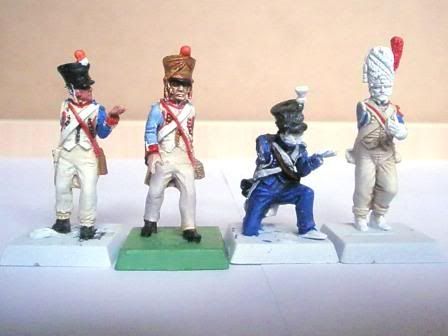
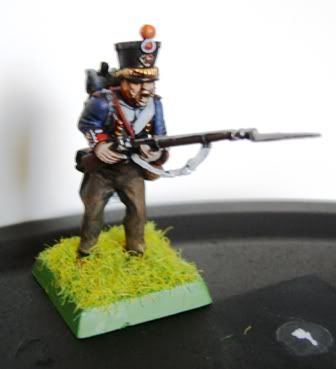
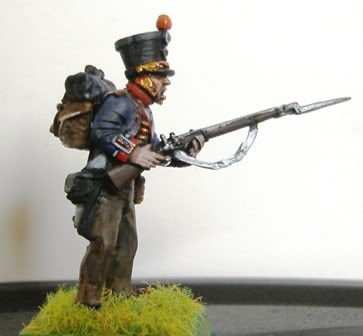
The first and second are line fusiliers, the third a legere chasseur, and the fourth a line grenadier.
Apart from the second in line, these show the new way I've experimented doing French blue, similar to the way I've been doing British red- a colour and wash technique, as opposed to just using a wash over white. It's okay, a bit shinier than I'd like, and harder to correct mistakes. You may notice they don't have arms; this is because I find it much easier to paint the chests without the musket-arm. Multi-part plastics can create poses much harder to paint than metals, where the firing arm would be "fused" to the chest, instead of distinct. For really close inspection, it does matter to paint that detail.

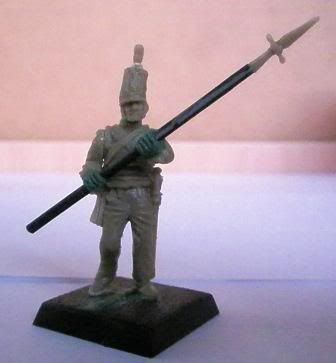
This is a conversion I've been planning for a while, giving an alternative to the one pose for sergeants given by the Victrix box. The hands are made from greenstuff, with the shaft of the spontoon made from an old plastic spear. The hands could do with some work, although there crudeness could be gotten around by painting them as gloves.

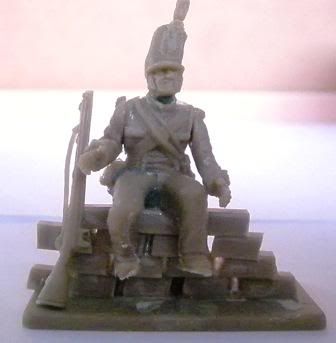
This is more whimsical, made from a kneeling trooper with his legs repositioned. Again, it's a bit rough-and-ready, but with a little cleaning up should look okay. I intend to put a facsimile newspaper in his hands, as if he's catching a cheeky break.

Monday, 9 August 2010

An Update

Well, it had to happen eventually. My heady student days are over! Time to grow up and get a job... apparently.

Unfortunately, I haven't kept to any of the resolutions I made in my post 'A Plan!'. I did start re-reading Campaigns of Napoleon again, but I got less of a way through it than I did the first time around. I think my painting speed is closer to 2 figs/week, and I haven't bought the foot artillery yet.

However, that aside, my new situation is going well, for painting at least. I'm managing to do a little each day, even if it's just blacking-in some boots or a shako. My current Napoleonic total stands at about 15 painted, 4 part-painted and 8 undercoated in readiness. All done, that'll be enough for their first outing.

Now for something a little bit different. Before I'd been muttering about 6mm miniatures, and their siren-call. Well, I've finally gotten around to painting some of the strips in the Baccus 18th Century sample pack that I bought, and I've taken some photos of the best for your review.


This strip of grenadiers is the best of the three infantry strips I've painted. I started from a white undercoat, mostly because that is the only spray I have but also because brightness of colour is very important on small figures. On the others I tried using thinned black washes to shade but at this detail depth the result is poor, the paint actually settling away from the recesses. This strip had no shading, just block painting over a white undercoat, making sure to 'fill in' properly, as you can't leave the white in the recesses as you could if you were using a black undercoat.


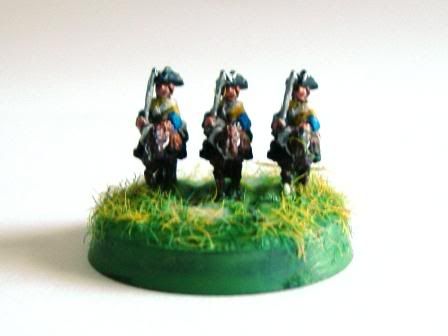
Here's a front and back view of three cavalry models mounted on a slottabase. These were painted much the same way as the grenadiers. The basing was an impromptu whim, making it look more 'playing piece' and less 'simulation'. I'd probably go with a lower base if I were to get more, although there would be the temptation if I were to use the higher bases to paint the lip in a different colour or add the regiment name to easily differentiate units on the tabletop, again making them more tokenesque.

So, my verdict? Not too difficult to paint, with the right size of brush, and my efforts look okay under the camera and at eye distance. I didn't time myself, but I think I probably made fairly good time for my first few attempts, so speed of painting is definitely borne out. At the very least, they're not taking longer to paint than an equivalent base-size of 28mms.

Wednesday, 16 June 2010

A Sense of Scale

For a long time (well, long for me), I've been considering 6mm miniatures. Peter Berry of Baccus Miniatures has a very convincing piece on his website extolling the virtues of 6mm over 28mm. Now, it's in his best interest to make 6mm seem appealing, but in looking at photographs on his site and on other peoples' blogs, I do like the massed look of 6mm. I'm also drawn to the speed of painting that comes with the lower level of detail. In particular, there are good pictures on Reinforcements by Post's website. I have two problems, however.

The first is that I've already invested in Napoleonics, and 28mm Napoleonics in particular. I've bought a reasonable number of books on the period, and two boxes of Victrix infantry. I like the look of 28mms, but my output is slow (a couple of hours per figure, at my relaxed speed) and my space is low. This blog has photographs of almost all the Napoleonics I've painted in two years*.

*My slow speed is mostly down to being at University and having to dig everything out in the holidays.

The second is that the Napoleonic period isn't the first period I'd choose to do in 6mm, for several reasons. Even in 6mm the uniforms are fairly detailed. I don't like the bayonets on Baccus figures, but Adler Miniatures are individual castings (Baccus come as a rank of four), and I dislike the thought of basing them all.

So the questions are, do I do 6mm at all? If so, do I do it alongside or instead of 28mm? In either case, should I do Napoleonics, or do another period?

Thursday, 10 June 2010

Some Conversion Ideas

One of the best things about the plastics revolution is the practically limitless way of combining the pieces to make your troops. Now, this isn't to everyone's tastes; a lot of complaints by grognards on TMP about Victrix and Perry are about the amount of time it takes to put them together. The big problem with plastics comes with characters.

Characters, by which I mean officers, sergeants, ensigns, drummers and so on, should be the focus of skirmish games. Most stories of daring-do focus on these, after all. Plastic sets fall down because of the limited number of bodies and heads for characters. The British sprue has one sort of officer body, and one sergeant body, whereas the French sprue has two officer bodies (line NCOs can be made from elite bodies, I've discovered).

So, my challenge to myself is to get out my greenstuff and knives, and convert some interesting personalities for my skirmish games.

Currently on the list (I'll expand this when I get ideas, or suggestions):

  • A Major who's missing an arm, Nelson-style
  • A Sergeant directing, or thrusting with spontoon

A Plan!

Finally having finished my degree, I'm left with a couple of free weeks before I graduate. As it's been a while (close to a year) since I last read any of Campaigns of Napoleon, I've decided to go back and begin reading it again from the beginning, taking notes as I go. I've set myself the somewhat ambitious target of reading 50 pages per day, which should put me halfway through by the time I graduate, with the momentum to finish.

Now I'm looking towards life after Uni, and enjoying the thought of getting back to regular painting again. My blog posts have been very infrequent, because I've only been able to paint during the holidays. Now I hope to get back into scheduled painting.

My first resolution is that I'm going to aim to paint at least eight miniatures a week, four coalition (British) and four Empire (French). I think this is an achievable target- two miniatures, four nights/week, and should quickly build up my forces. In three weeks, I'll have enough for small skirmishes.

My second resolution is to get the new Victrix British foot artillery. People on TMP seem to be quite excited about this set, because it includes limbers which were apparently very expensive to have in metal. All I know is that it's plastic (tick!), suitable for the Peninsular war (tick!) and made by Victrix (tick! tick!).

Thursday, 15 April 2010

Painting Again! Hurrah!


I've finally managed to be home long enough to do some more painting, and managed to finish a British sergeant. The pictures aren't the best, but I'm quite happy with him.

I have chosen to paint his facings green; I am going to experiment with other facing colours on some of the line infantrymen, but wanted to make sure I'd be happy with his colours.

Friday, 8 January 2010

Curiouser and Curiouser...

When I logged onto TMP today, I received a PM telling me that an anonymous donor had arranged for me to have a free year of Supporting Membership. This came as quite a surprise as to be honest I hadn't thought I'd made any waves on TMP. However it all seems to be genuine, so to my anonymous benefactor- Thank-You!

Something a Bit Different

A while back a very generous person on the TMP gave me a book on Napoleonic uniforms. It's a mine of information, and is especially good because several of the uniforms are French infantry-style (or close enough for a bit of putty and a knife to fix), which means that I can take a break from all the blue and paint my Victrix in different colours.

The first such break is a Voltigeur based on plate 55, from the Régiment Irlandaise. It's been a bit different painting him- the green is four sucessive coats (thinned yellow, GW green wash, thinned dark green, green wash again) which I'm still not immensely happy with. That said, I really like this uniform scheme so I think I'll perservere.


Now, the plume pictured has order (from the top) of yellow-green, which I've copied. However, I've seen other pictures of voltigeurs (including one in the same book) that go green-yellow. I'd be grateful if I've made a mistake to be corrected for next time.

Birthday Brits

It's been my birthday recently, and for it I got a shiny box of Victrix centre-company British. It was a toss-up whether I asked for flank or centre companies- on one side, the roles of the flank companies could fit more easily with the skirmishing I plan to do; on the other side, I think the shoulder wings look a bit silly and if I ever do go into full battles I'll need fewer flank company figures than centre.

They're a little easier than the French to paint, I think, partially because the French have more piping and buttons. The straps are done fairly easily, with a dark brown wash over the white undercoat, and then picking them out with a fine brush, and the lace is just a once-over with the wash. I haven't made a distinction on these two between the white straps, the strap for the water canteen (brown) and the strap for the haversack (greyish-natural). Now I'm used to the miniatures I might start, although if it looks to messy I'll go back. I'm not particularly fussed in dropping accuracy for aesthetics.


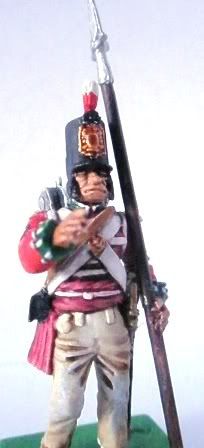
This is the first I painted. I'm quite happy with him, especially how well (entirely by fluke) I've managed to keep his collar white-piped. Less good is his canteen, but that's an area of improvement.


So far, I've painted one with green facings and the other with blue. One of the suggestions on a TMP discussion that I may implement is to create my own regiment, as the protagonists (or antagonists) in my skirmish campaigns. That way, I can freely have caddish cads, vile villains and heroic heroes without insulting any real-life figures. Of course, this is probably a bit wooly for some people but I like to have stories and conflict in wargames, which is perhaps why I like various forms of RP.

One of the big decisions then is what colour to paint the facings, which I haven't yet decided. As much as I would like bright purple facings I'd quite like to keep them historical, but beyond that I only have two conditions. The first is that they can't be buff, because it's boring, and the second is that they can't be yellow, because that is far too Sharpe and his South Essex.

Two New French

For Christmas, I received some GW washes and white undercoat, with which to work out a new style of painting that better fits the fiddlyness of Napoleonic uniforms, and I think I've almost cracked it. I hope you agree!

The first miniature I painted was a fusilier, using the blue wash for his coat colour. I'm not unhappy with it, but the sergeant has a better colour which is a first wash of a thinned-down humbrol blue and then the blue wash over the top for shading.

The whites are now done with the sepia wash straight over the undercoat, then hilighted with white. It gives sufficient shading whilst looking a little bit grubby in the process. I want to strike a balance between parade-ground and the full raggle-taggle nature of the reality, and this does it for me.

The fusilier sergeant is much the same, composed out of a voltigeur/grenadier body with fusilier arms and head. I'm not sure if I got the slashes correct, I have a feeling they should have been lower down. The sword & bayonet belt also needs some black.

You may have noticed that all of my line so far have had the orange pom-poms of the third company. Because I plan on doing skirmishing actions I want enough from a single company to be believable. I settled on the third company because I like orange!

Saturday, 28 November 2009

A Burgeoning Library

Before the rest of my post, I would like to say thank-you to Noel of Garage-gamer. After asking about books on Napoleonic uniforms he kindly and generously gave me a copy of Uniforms of the Peninsular War, despite me being a complete stranger on a message board. Jolly stand-up chap.

Since deciding on learning about the Napoleonic period, I've gathered together about half a dozen books on the subject. Currently, I have:

  • The Campaigns of Napoleon, Chandler
  • The Art of Warfare in the Age of Napoleon, Rothenberg
  • Napoleon, Cronin
  • A Dictionary of the Napoleonic Wars, Chandler
  • Uniforms of the Peninsular Wars, Haythornthwaite
I've read through The Art of Warfare twice, and Campaigns and Napoleon are both in a state of being read.

I'm finding Campaigns a fairly hard read; it's very information-dense, which I'm finding means often the minutiae obscures the ebb and flow of the campaign it describes. However, I can't fault it on being thorough, so I shall plough through it.

Napoleon
, on the other hand, is a more general biograph, filled with the sort of biographical details that make interesting reading. It has a lot of anecdotes about Napoleon, some of which I'm not sure whether I need to take with a pinch of salt, but in general I'm finding a good read.

The Dictionary has been consulted once or twice, but only over small things. It also seems more focussed on personalities than some of the more technical aspects of war (it has no entry for brigade or battalion, when I wanted to check what sort of size these were).

My first offerings!


I've uploaded a couple of pictures of my first painted Napoleonic French soldier. They aren't the best pictures in the world, but hopefully my photography will get better. I've painted a couple more since him, slightly varying my technique each time but not making much in the way of technical progress.

My first thought? Lots of white belts and trim that need to stand out against other colours is a right pain to paint! I've tried using a grey basecoat, white on top, black wash for the recesses and then more white. It looks...okay...but not brilliant. I'm thankful of the side-of-the-box guide to the uniforms and good box artwork which I used as my painting guide so far.

In comparison to GW plastics, the Victrix are very slight, much better proportioned (whilst I still like the GW style, put some Empire humans next to the Victrix and they'll look like mutants!). This, combined with a couple of years out from painting (being a student and flitting between home and Uni means I haven't done much painting over the last few years) means he isn't my best work.

Whilst I've painted a half-dozen so far, my plan is to radically change the way I paint in the future. Inspired by this post I'm going to use a white undercoat and inks (which did me very well in my early days) and hopefully perfect a method that is very neat.

Wednesday, 5 August 2009

An Introduction and a Mission Statement

My entry into Napoleonic wargaming is entirely cliché. I began making Airfix models at nine (mostly tanks and aeroplanes) before being introduced to Games Workshop around eleven. Through my teens I was up to my knees in Dwarves and Hobbits, before veering off at a tangent into RPGs. Endless repeats of Sharpe and Hornblower got me intrigued about the Napoleonic period, and coupled with the recent advent of hard plastic Napoleonic-era miniatures, I decided to take the plunge.

I want this blog to be a record of the process of going from complete newbie to hardened grognard. Learning the history, doing the research, and collecting the forces that hopefully I'll lead to victory.

En Avant, mes légions en plastique!